
T: +86-18906892820
F4-19037-6#, Yiwu Intl Trade Mart, Yiwu Jinhua, Zhejiang, China (Mainland)

Views: 132 Author: Site Editor Publish Time: 2026-09-16 Origin: Site


Opening a live distribution circuit without proper arc interruption mechanisms risks catastrophic arc flashes, equipment destruction, and severe operator injury. Utility operators and linemen must navigate varying grid hardware configurations daily. You must distinguish between standard non-loadbreak cutouts and integrated loadbreak cutouts to determine exact operational protocols for dropping load safely. Real-world field experience dictates that standard cutouts are not designed to drop even moderate loads, such as 100 amps, without specialized interruption equipment. This guide breaks down the technical thresholds, safety mandates, and equipment configurations that dictate exactly when a portable load bust tool is a mandatory requirement for fuse cutout operation, alongside an evaluation of alternative hardware solutions.
Mandatory Usage: A load bust tool is strictly required when opening any standard (non-loadbreak) fused cutout, disconnect switch, power fuse, or fuse limiter while the circuit is under continuous load.
Safety & Compliance: Operating standard cutouts under load with only a standard hot stick violates utility engineering standards and exposes operators to high-velocity particles, hot gases, and arc flash hazards.
Hardware Distinction: Integrated loadbreak cutouts and link-break cutouts offer built-in arc interruption, eliminating the need for a portable load bust tool, but require higher upfront per-pole capital investment and have lower continuous current ratings.
Operational Limits: Portable load bust tools must be matched to system voltage (e.g., 14.4 kV to 34.5 kV) and maximum continuous current ratings (typically up to 600 amps or 900 amps depending on the model).
Standard non-loadbreak cutouts serve a highly specific function on the distribution grid. Engineers design them solely for fault protection and isolating de-energized lines. They consist of a simple fiberglass or porcelain insulator body, a conductive trunnion, and a fuse tube. When a fault occurs, the internal fuse link melts, the tube drops open, and the circuit breaks. However, these standard units lack any internal mechanisms to extinguish an electrical arc when a lineman opens them manually under load. The physical gap created by pulling the door open cannot stop the flow of electricity on its own.
A portable load bust tool acts as a lightweight, temporary interrupter switch that linemen carry directly to the pole. You attach it to the end of a standard fiberglass hot stick. The tool bridges the gap between the upper contact of the cutout and the pull ring on the fuse tube. As you pull down on the stick, the tool provides a contained environment to safely extinguish the arc. It manages the extreme thermal energy during the entire opening sequence, carrying the current momentarily before breaking the circuit internally.
Dropping load on a medium-voltage circuit involves violent physics. When contacts separate under continuous current, the air between them ionizes instantly. This ionization creates a highly conductive plasma channel. The circuit remains closed through this superheated plasma, which can reach temperatures exceeding 35,000 degrees Fahrenheit. Dielectric breakdown occurs the exact moment the metal contacts part. The system voltage actively pushes current across the growing physical gap. Without mechanical intervention, this arc stretches, burns, and melts surrounding hardware until the gap becomes too wide or the system faults out entirely.
The portable interrupter rapidly elongates this arc to break the circuit safely. When the lineman pulls the tool, internal heavy-duty springs trip. These springs force the internal contacts apart at extremely high speeds, far faster than a human can pull a stick. The tool introduces de-ionizing gases directly into the arc path. Ablative materials inside the tool's muffler react to the intense heat of the plasma. They release specific gases that cool and choke the arc. This action interrupts the current flow precisely at the first current zero-crossing. Because alternating current cycles through zero volts 120 times per second on a 60Hz system, the tool leverages this natural drop in voltage. It prevents the arc from restriking after this critical zero point, securing the open circuit.
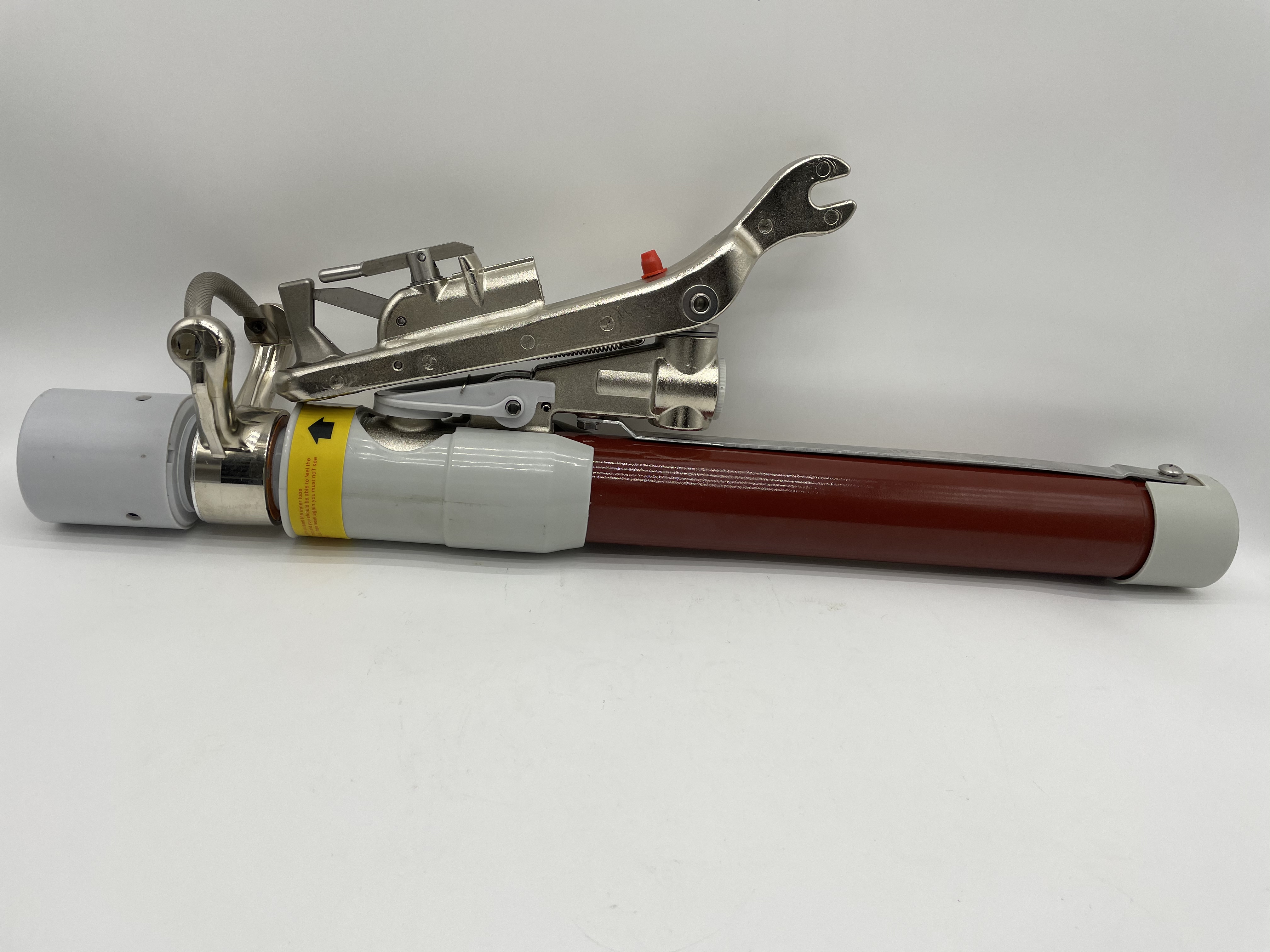
Any operation involving the opening of a standard cutout, power fuse, or fuse limiter carrying load current requires the tool. You cannot safely drop seemingly low loads on standard hardware. Even 100 amps will sustain a dangerous, uncontrolled arc that can jump phases. Linemen must treat every energized, loaded circuit with absolute caution. Assuming a low load is safe to pull with a bare stick is a severe operational error that leads to immediate equipment damage and potential injury.
Utility engineering standards dictate strict switching rules across the industry. Seattle City Light standards, along with many other major utilities, provide clear directives. Operators can use a standard hot stick with a disconnect hook for closing the cutout. However, a portable interrupter is strictly required for opening it. You never pull a loaded standard cutout with just a stick. The risk of sustaining a massive arc remains too high, regardless of ambient weather conditions, humidity, or the skill of the operator.
Dropping line-charging currents requires specialized handling. Capacitor banks store massive amounts of energy and regulate grid voltage. Heavily loaded distribution transformers present unique switching challenges due to their magnetic cores. These devices do not simply stop drawing current when contacts part. Capacitive currents lead the voltage, making interruption at the zero-crossing much more difficult. The voltage remains near its peak even when the current hits zero, encouraging the arc to restrike across the gap.
Inductive loads create severe transient recovery voltages (TRV). The voltage spikes dramatically the moment you break the circuit. Standard cutouts cannot handle this sudden, aggressive voltage surge. The arc will easily restrike across the open air gap, defeating the attempt to open the circuit. A portable interrupter manages this TRV safely. Its internal muffler and rapid contact separation absorb the energy spike. The ablative gases restore the dielectric strength of the gap faster than the TRV can rise, preventing a restrike entirely.
Linemen perform load transferring regularly during routine maintenance. Emergency sectionalizing happens when circuits cannot be de-energized upstream due to critical loads like hospitals or water treatment plants. You must isolate specific grid sections quickly to repair storm damage or replace broken poles. The portable interrupter allows safe isolation without dropping the entire feeder. Operators bypass damaged sections efficiently, keeping the lights on for the majority of the circuit.
They maintain power to downstream customers while isolating the fault zone. The tool ensures every switching action remains contained and safe. Without it, operators would have to travel miles upstream to open a larger substation breaker or a gang-operated switch. This action would drop thousands of customers unnecessarily just to isolate one lateral tap. The tool provides granular control over the distribution network, allowing crews to work safely on isolated segments.
Pulling a loaded standard cutout with a standard hot stick invites disaster. You unleash uncontained arcs directly into the open air. The extreme heat causes the rapid expulsion of hot gases and vaporized metal. High-velocity molten copper and silver particles spray outward from the contacts. These particles can easily reach the operator standing on the ground or working in the bucket truck. The acoustic blast alone can cause permanent hearing damage, while the ultraviolet light can cause flash burns to the eyes.
The portable interrupter secures the opening process, but operators must understand that closing presents different risks. Closing a non-loadbreak cutout fuseholder into a fault remains dangerous. A hot stick pushes the door closed. If a hard fault exists on the line, the fuse link blows instantly upon contact. The tube expels dangerous hot gases directly from the bottom exhaust port. You must stand clear of this exhaust path during closing operations. The tool does not protect you during the closing sequence; it is strictly an opening device.
OSHA strictly regulates live-line work to prevent these exact scenarios. NFPA 70E defines specific arc flash boundaries to protect workers from thermal energy. Operating standard cutouts under load without proper interruption violates these boundaries entirely. It exposes workers to incident energy levels that far exceed their standard flame-resistant PPE ratings. Compliance requires using the correct interruption device every single time you break a loaded circuit.
Uncontained arcing generates thousands of degrees of heat in a fraction of a second. This intense heat pits and destroys the silver-plated contacts on the cutout body and the fuse door. The cutout trunnion suffers severe burn damage from the plasma. Repeated arcing degrades the mechanical integrity of the entire assembly. The cutout will eventually fail to carry its rated continuous current. This degradation leads to localized overheating, thermal runaway, and eventual mechanical collapse of the switch.
An uncontained arc does not always extinguish itself safely. The ionized gas cloud can drift with the wind. It may contact adjacent phases, crossarms, or grounded pole hardware. This creates a massive phase-to-phase or phase-to-ground fault right at the pole top. Upstream breakers or reclosers will trip immediately to clear this new fault. A simple, routine switching operation quickly escalates into a wider, unplanned outage affecting thousands of customers, all because a lineman skipped using the proper tool.
Manufacturers produce integrated solutions like the ABB LBU series. These devices feature built-in arc chutes directly on the cutout body. They incorporate load-breaking contact mechanisms directly into the fuseholder design. Linemen operate them with a simple, standard hot stick. The internal chute manages the arc automatically as the door falls open. You pull the door, the internal contacts separate inside the chute, and the arc extinguishes before the main external contacts part.
This approach eliminates the need for linemen to carry a specialized tool on the truck. It reduces the number of live-line tools requiring monthly maintenance and testing. However, it significantly increases the hardware capital cost per pole. Integrated cutouts also face strict operational capacity limits. They typically handle lower continuous current limits. You usually see ratings around 100 to 300 amps. In contrast, a portable tool easily handles 600 to 900 amps, giving operators much more flexibility on heavily loaded main feeders.
Hubbell and other manufacturers offer mechanical link-break systems. The operator uses a standard hot stick for this operation. They hook the special link-break lever on the fuse door and pull downward. This mechanical action physically snaps the fuse link inside the tube before the upper contacts part. The fuse tube itself acts as the arc chute, extinguishing the resulting arc just as it would during a fault condition.
This method breaks the load safely without a specialized interrupter. However, it requires the physical destruction of the fuse link every single time you open the switch. You must replace the broken link prior to closing in for every operation. This requirement increases maintenance time drastically. Consumable costs rise with every switching action. It slows down emergency restoration efforts when time is critical, as linemen must re-fuse the door before re-energizing the line.
Cutout Load Interruption Methods Comparison
Interruption Method | Arc Extinguishing Mechanism | Continuous Current Capacity | Operational Trade-offs |
|---|---|---|---|
Standard Cutout + Portable Tool | Internal ablative muffler in the portable tool | High (600 - 900 Amps) | Requires tool maintenance; lowest per-pole hardware cost. |
Integrated Loadbreak Cutout | Built-in arc chute on the cutout body | Low to Medium (100 - 300 Amps) | No special tool needed; higher per-pole capital cost. |
Link Break Cutout | Mechanical snapping of the fuse link | Medium (Up to 300 Amps) | Destroys fuse link on opening; increases restoration time. |
You must align tool specifications directly with your specific grid parameters. Assess the maximum design voltage in kilovolts (kV) across your territory. Verify the continuous and interrupting current capabilities in amperes (Amps). The tool must exceed the maximum possible load at the specific switching point. Under-rating the tool leads to catastrophic failure, as the internal muffler will not contain the thermal energy of a load that exceeds its design limits.
Never use tools rated for 15kV on 25kV or 34.5kV distribution systems. The internal arc chute cannot handle the higher recovery voltage. The arc will restrike inside the tool after the zero-crossing. This causes violent tool failure, blowing the muffler apart and causing severe operator injury. Always verify the stamped nameplate rating before attaching the tool to the hot stick. Utility safety managers must audit truck inventories to ensure linemen only carry tools rated for the highest voltage present on their specific system.
The grid contains various brands of disconnects and cutouts. You will find different fuse limiters and power fuses deployed across the network over decades of construction. The tool must interface perfectly with all of them. A universal design helps, but physical verification remains necessary. You cannot guess when dealing with live-line operations. S&C, Hubbell, Cooper, and ABB all have slight variations in their pull ring and upper contact designs.
Verify the tool's pull-ring hook fits the cutout door perfectly. The upper anvil must seat securely against the upper contact of the cutout. A loose fit causes the tool to slip during the aggressive opening stroke. If the tool slips under load, it draws an uncontained arc outside the muffler. Test compatibility in the training yard before deploying new tools to the field. Linemen must practice seating the tool on de-energized hardware to build muscle memory.
Load bust tools are highly stressed mechanical devices. They absorb massive amounts of electrical and kinetic energy during every single operation. They are subject to significant internal wear and tear. You cannot treat them like standard hand tools or simple fiberglass sticks. They require a rigorous, documented lifecycle management program to ensure operator safety and reliable performance.
Establish a strict schedule for routine visual inspection. Look for cracked housings, bent anvils, or loose hardware. Perform stroke testing weekly to ensure smooth mechanical operation and proper reset action. Monitor the internal operation counter diligently. Replace internal mufflers, springs, and contacts based on strict operation counts. Manufacturers define exact cycle limits for these consumable parts, often requiring a rebuild after 1,500 to 2,000 operations. Ignoring these limits guarantees eventual tool failure under load.
A portable interrupter is a non-negotiable safety requirement for utility operations. You must use it for opening standard fuse cutouts under load. Attempting to drop load without one on standard hardware is a severe safety violation that risks lives and grid stability. The physics of arc interruption demand a contained environment to safely break continuous current.
Utilities face a clear operational choice. You must weigh operational flexibility and higher amperage capacity against capital expenditure. Standard cutouts paired with portable tools offer lower per-pole costs and higher interruption ratings. You must compare this against the higher upfront cost of integrated loadbreak cutouts. Integrated units offer simplified operation but lower overall capacity.
Take the following steps to ensure safe switching operations:
Conduct a comprehensive field audit of current distribution hardware to identify all non-loadbreak cutouts on your system.
Update lineman safety protocols to explicitly mandate portable interrupter usage for all live-line opening operations.
Establish a documented maintenance schedule for all portable load interruption tools, tracking operation counts for mandatory rebuilds.
Verify voltage and amperage ratings on all truck-mounted interrupters to ensure they match or exceed your maximum grid specifications.
A: A lightweight, portable loadbreak tool used by utility workers to safely open energized disconnect switches, cutouts, fuse limiters, and power fuses by internally extinguishing the electrical arc created when breaking the circuit.
A: No. Opening a standard, non-loadbreak cutout under load without a specialized tool will draw a dangerous electrical arc, risking severe injury, equipment damage, and system faults. Even dropping loads as low as 100 amps requires the tool.
A: A loadbreak cutout has a built-in arc-extinguishing mechanism allowing it to be opened safely under load with a standard hot stick, though usually limited to 100-300 amps. A standard cutout lacks this mechanism and requires a portable tool for safe load interruption.
A: Depending on the specific model and manufacturer, standard portable load bust tools are typically rated to interrupt continuous currents ranging from 600 amps up to 900 amps.
A: Yes. Because they absorb the energy of electrical arcs, internal components like contacts, mufflers, and operating springs degrade over time and must be inspected, tested, and rebuilt according to the manufacturer's operation cycle limits.
A: While many tools are designed to be universally compatible with standard distribution hardware, operators must verify that the tool's attachment mechanisms properly seat onto the specific cutout's pull ring and upper contact before operation.


