
T: +86-18906892820
F4-19037-6#, Yiwu Intl Trade Mart, Yiwu Jinhua, Zhejiang, China (Mainland)

Views: 159 Author: Site Editor Publish Time: 2026-07-07 Origin: Site


De-energizing capacitor banks presents severe operational hazards compared to standard inductive or resistive loads. Trapped charges, high recovery voltages, and restrike potential create uniquely dangerous environments for utility workers. Relying on improper switching equipment or standard disconnects risks massive arc flashes. Rapid equipment degradation and serious operator injury often follow these poorly matched applications. You simply cannot ignore the physics behind capacitive currents. Transitioning to a specialized load break tool requires precise planning. You must rigorously evaluate technical specifications and assess your exact system voltage requirements. Furthermore, understanding the distinct operational limitations of portable versus permanent switching solutions ensures reliable field performance. This guide will help you navigate these critical safety choices to protect your crews and infrastructure.
Capacitive currents require specialized arc-interruption mechanisms to prevent restrikes and high-frequency transients.
Selecting a capacitor load break tool requires matching maximum voltage recovery ratings with specific field cutout compatibility.
While portable tools offer cost-effective, multi-site utility, heavy-duty applications may require evaluating permanent switchers with pre-insertion resistors.
Implementation success depends heavily on rigorous tool maintenance and adherence to OSHA/IEEE switching protocols.
Standard distribution cutouts handle everyday resistive loads exceptionally well. They fail dangerously when facing capacitive banks. The reason lies strictly in electrical physics. Capacitors naturally create a leading power factor within the grid. The alternating current leads the system voltage by exactly 90 degrees. When an operator attempts to break the circuit, the electrical arc naturally extinguishes at the moment of current zero. However, because of this 90-degree phase shift, the system voltage reaches its absolute peak at this exact microsecond.
A standard disconnect switch separates its metal contacts too slowly. It fails to build adequate dielectric strength across the widening air gap. The trapped electric charge stored inside the capacitor bank clashes violently with the rising recovery voltage from the distribution system. This massive potential difference easily jumps across the inadequate air gap. We call this dangerous phenomenon a restrike.
Restrikes re-ignite the electrical arc with intense explosive energy. The real-world consequences are severe for both infrastructure and personnel. System overvoltages multiply rapidly during a restrike event. High-frequency transient surges travel instantly down the distribution lines. They routinely damage adjacent transformers, weaken insulation, and destroy surge arresters. More importantly, restrikes create massive arc flash risks. Operators standing at the base of the utility pole face extreme physical danger from molten metal and concussive blasts.
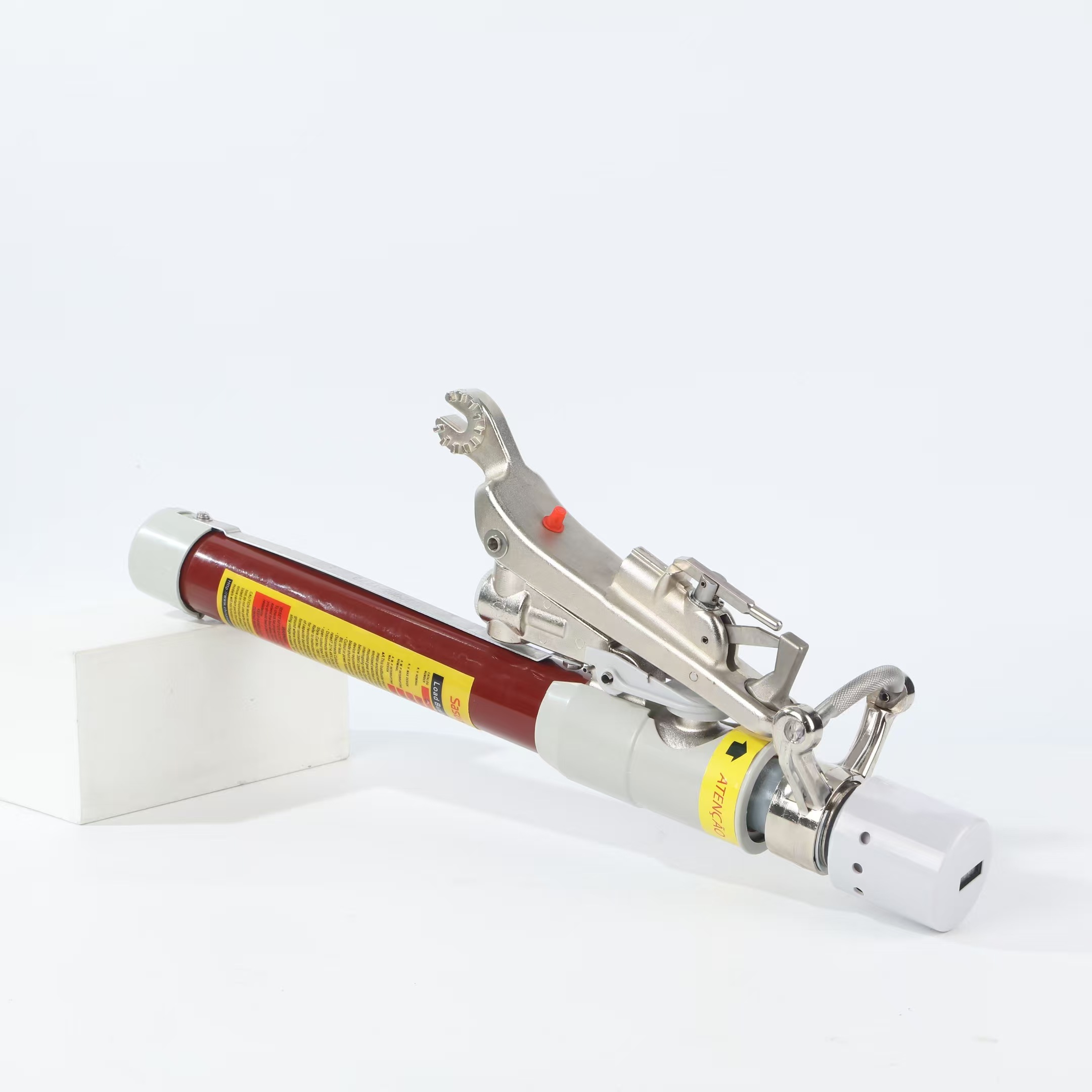
Choosing the right capacitor load break tool requires analyzing several core specifications. You cannot treat these precision instruments like basic utility hot sticks. They require stringent engineering validation before field deployment.
You must rigorously verify the tool’s maximum design voltage against your nominal system ranges. A tool rated for 15kV class distribution will fail catastrophically on a 27kV or 38kV system. Operators must also distinguish clearly between general load switching ratings and specific capacitive switching currents. Capacitive ratings are often much lower than general continuous current limits. Pushing a tool beyond its specific capacitive rating invites immediate dielectric breakdown.
Evaluate the internal arc-quenching mechanism carefully. High-speed spring-loaded contacts ensure rapid mechanical separation. They pull the internal gap apart much faster than the recovery voltage can spike. Many devices utilize ablative snuffer tubes. These tubes emit a specialized cooling gas when exposed to the heat of the arc. This gas instantly deionizes the air and extinguishes the plasma. Heavy-duty models might utilize sealed vacuum bottles instead. Vacuum environments provide superior dielectric recovery because they eliminate the oxygen needed to sustain an arc.
Line workers operate these devices manually at the end of extended fiberglass hot sticks. Tool weight becomes a critical fatigue factor during long shifts. Heavy devices cause instability during precise maneuvers. An unbalanced tool leads to improper seating on the cutout. Furthermore, you must verify physical compatibility. The switching device must interface seamlessly with your existing distribution cutouts, disconnect switches, and power fuses without requiring clumsy adapters.
Every single switching event degrades the internal components. Assess the expected operational lifespan accurately. How many open operations can it perform safely before requiring complete service? You need to know exactly when to replace internal copper contacts or degraded ablative components. Ignoring duty cycles leads to in-field failures.
Utility managers must ultimately decide between deploying portable tools or investing in fixed installations. Both approaches serve distinct operational needs across the distribution grid.
Portable solutions deliver highly cost-effective utility. A single operator carries one unit from pole to pole in their service truck. They offer immense flexibility across multiple substations and rural feeders. You completely eliminate the need to install expensive, individual switch mechanisms on every single capacitor bank in your territory. However, they possess distinct operational drawbacks. They rely entirely on manual operator intervention and perfect physical technique. They also strictly break the load. When you close the circuit again, a portable device does not mitigate system-level inrush currents at all.
Permanent switchers provide automated, remote-controlled operation. They operate independently of crew availability. They often utilize advanced pre-insertion resistors or inductors. These components temporarily limit damaging inrush currents and voltage transients upon closing the circuit. They are ideal for high-frequency switching tasks, such as daily power factor correction on volatile industrial feeders. The downside is steep upfront capital expenditure. They also require permanent installation at a single fixed site, limiting their territorial utility.
Use the following breakdown to shortlist your switching strategy based on operational frequency, budget constraints, and system vulnerability.
Evaluation Factor | Portable Load Break Tool | Permanent Switcher (Pre-Insertion) |
|---|---|---|
Primary Application | Infrequent, manual maintenance switching | Daily, automated power factor correction |
Inrush Mitigation | None (Opening operations only) | Excellent (Utilizes resistors/inductors) |
Upfront Investment | Low (Cost-effective across entire fleet) | High (Significant site-specific capex) |
Operator Involvement | Manual operation via insulated hot stick | Remote SCADA control or local relays |
Buying the right equipment only solves half the problem. Field execution and maintenance discipline determine ultimate safety.
Internal ablative materials and metal contacts degrade with each use. Arc-quenching gases deplete naturally over time. You must acknowledge this continuous degradation curve. We strongly recommend using models featuring built-in mechanical operation counters. Tracking exact field usage prevents dangerous equipment failures. Relying on memory or guesswork for maintenance schedules puts lives at risk.
Never assume a device is ready for use simply because it looks clean. Implement strict visual and mechanical checks before every single operation.
Inspect the external composite housing for deep cracks or extensive carbon tracking.
Verify the internal reset mechanism engages smoothly and locks securely into place.
Examine the internal muffler and snuffer tube integrity for excessive burn wear.
Check all moving metal parts for proper lubrication and absence of environmental debris.
Procurement and daily usage must align strictly with industry safety standards. Follow all OSHA safety mandates regarding high-voltage clearances and PPE requirements. Additionally, ensure your equipment complies directly with the IEEE C37 series standards governing high-voltage switching behavior. Adhering to these rigorous frameworks demonstrates a clear commitment to recognized safety baselines and protects utility liability.
Even the best engineering fails if handled poorly in the field. Operator training remains absolutely vital. Crews must practice consistent, straight pull-angles. Lateral forces bind the internal mechanisms. They should operate the hot stick smoothly, without hesitation or jerking motions. Proper hot-stick handling ensures the internal spring mechanism triggers correctly and achieves maximum separation speed. Hesitation during the pull can cause the contacts to stall mid-stroke, inviting a catastrophic arc flash.
Moving from technical evaluation to active procurement requires a highly structured approach. Follow these practical steps to secure the right fleet equipment.
Map out all current capacitor bank locations across your distribution grid.
Identify the specific voltage classes and fault current ratings for each installation.
Catalog the exact cutout brands and models currently mounted on your utility poles.
Determine your primary operational goals clearly. Are you trying to reduce operator risk during routine seasonal maintenance? Perhaps you want to decrease unexpected maintenance downtime caused by restrikes. You might simply need to standardize fleet equipment across different utility districts to simplify training. Clear metrics guide much better purchasing decisions.
Do not buy purely off marketing specification sheets. Advise your procurement team to request empirical testing data directly from the manufacturers. Ask for physical field-trial units. Let your senior line crews test them in controlled environments. Verify physical cutout compatibility and evaluate overall operator comfort before committing to bulk purchases.
Mitigating the inherent dangers of capacitive switching requires moving completely beyond generic disconnects. You need specialized equipment explicitly designed for the extreme physics involved. An evidence-based procurement decision carefully balances arc-extinguishing capabilities with grounded operational realities. You must continuously consider field maintenance routines and operator ergonomics to ensure long-term success. Promptly consult with your engineering team today. Review your system single-line diagrams carefully to identify high-risk nodes. Finally, contact a technical sales representative to schedule a comprehensive tool compatibility assessment. Protect your crews and stabilize your grid by choosing the correct specialized switching solutions.
A: No. You must only use tools explicitly rated for capacitive switching. Capacitors create unique voltage recovery characteristics. The system voltage peaks exactly when the alternating current hits zero. Standard tools cannot build dielectric strength fast enough to prevent a restrike. Using them on capacitors invites severe arc flash hazards.
A: Maintenance schedules depend on operation counts, not strictly calendar time. Most high-quality tools require internal servicing after 1,500 to 2,000 operations. Operators must perform visual inspections before every use to check arc-quenching materials and contacts for degradation. Always rely on the built-in operation counter to trigger formal maintenance.
A: No. Portable tools are strictly designed for load breaking, which means de-energizing the circuit. They provide zero mitigation for inrush currents during closing. If you need to manage inrush transients upon energization, you must install permanent pre-insertion devices, specialized inductors, or synchronized closing relays.
A: Portable tools generally cover standard distribution ranges. You will typically find them rated for 15kV, 27kV, and up to 34.5kV or 38kV systems. Higher transmission-level voltages exceed the safe physical limits of portable hot-stick operations. Those extreme voltage classes require specialized, permanently installed circuit breakers.


