
T: +86-18906892820
F4-19037-6#, Yiwu Intl Trade Mart, Yiwu Jinhua, Zhejiang, China (Mainland)

Views: 0 Author: Site Editor Publish Time: 2026-11-08 Origin: Site


Procuring bulk electrical hardware carries heavy operational stakes for power grids. Minor unit cost variations scale rapidly across thousands of miles of distribution lines, directly impacting capital expenditure budgets. Conversely, deploying substandard pole-to-wire insulation leads to premature material degradation, grid downtime, and safety hazards for line crews. Procurement managers and utility engineers constantly navigate the tension between securing aggressive wholesale pricing and ensuring strict adherence to mechanical and electrical specifications. Critical parameters like Basic Impulse Level (BIL) ratings, cantilever strength, and dry arc distance cannot be compromised for upfront savings. This guide establishes technical evaluation frameworks for pole-line hardware. You will gain a clear roadmap for vetting high-volume suppliers, verifying factory production capacities, and safely navigating global sourcing channels to secure reliable grid infrastructure components. Understanding the underlying cost drivers of manufacturing and international freight helps utility buyers negotiate stronger contracts while eliminating the risk of field failures.
Accurate wholesale quoting requires defining rigid technical parameters based on specific environmental and operational demands. Suppliers cannot provide reliable volume pricing without a comprehensive technical specification sheet detailing the exact stresses the hardware will endure in the field. Establishing these baseline requirements prevents miscommunication during the quoting phase and ensures all competing manufacturers bid on identical specifications.
Basic Impulse Level (BIL) requirements dictate the physical size, shed profile, and ultimate manufacturing cost of the hardware. BIL measures the maximum voltage surge the component can withstand without flashing over. Lightning strikes or switching surges on the network typically cause these spikes. Higher BIL ratings demand larger physical dimensions, increasing raw material usage and extending kiln firing times for ceramic variants. Utility engineers must specify the exact BIL rating required for their specific grid segment before requesting quotes.
Creepage distance calculations depend entirely on local pollution and contamination levels. Coastal areas with heavy salt spray or industrial zones with high airborne particulate matter require extended creepage distances to prevent surface tracking. Engineers classify these environments into Light, Medium, Heavy, and Very Heavy pollution zones. Extending the creepage distance means adding more sheds or increasing the shed diameter. This design alteration directly influences the unit volume and packaging density, which subsequently impacts international shipping costs per container.
Cantilever strength ratings determine the hardware's ability to support conductor weight while resisting lateral environmental stressors like high winds and ice loading. The Pin Insulator must maintain structural integrity under continuous mechanical tension. Failure to specify the correct cantilever strength leads to spindle bending or catastrophic fracture at the crossarm mounting point. Procurement documents must clearly state the required minimum failing load (MFL) to ensure the factory utilizes the correct internal core diameter and material density.
Exact thread matching guarantees a secure mechanical connection to existing crossarms. Distribution networks typically utilize specific thread standards, such as 1-inch or 1-3/8-inch ANSI standard threads. A mismatch between the internal thread and the steel spindle renders the entire batch useless. Line crews cannot modify threads in the field. Discovering a mismatch during installation causes severe project delays, wasted truck rolls, and requires complete batch replacement. Verifying thread gauges during the pre-production phase is a mandatory step in bulk procurement.
Procurement teams must distinguish between the insulating body and the supporting metal spindle. Bundling the forged steel pins with the main order ensures factory-level thread compatibility verification. While sourcing spindles separately from specialized fastener manufacturers might yield fractional unit savings, it introduces significant dimensional mismatch risks and complicates warranty claims if a mechanical failure occurs during installation.
When drafting your initial request for quotation (RFQ), ensure you include the following technical parameters:
The primary material classifications for distribution line insulation heavily influence wholesale procurement strategies, shipping logistics, and installation timelines. Selecting the appropriate material requires balancing upfront unit costs against freight expenses and field deployment efficiency.
Porcelain remains the historical standard for distribution networks. It offers superior track resistance, exceptional longevity, and proven performance in highly abrasive environments. The rigid inorganic structure resists UV degradation and surface arcing better than early-generation polymers. Manufacturing involves complex extrusion, shaping, glazing, and high-temperature kiln firing. This results in a highly durable, fully vitrified product that does not absorb moisture.
Porcelain introduces specific logistical challenges that impact procurement budgets. While raw material costs remain relatively low, the high density of porcelain drastically increases freight expenses. Ocean freight and inland trucking costs scale directly with cargo weight. Porcelain's brittle nature requires procurement managers to factor in a higher risk of transit breakage. Standard practice involves over-ordering by a specific percentage to account for units damaged during international shipping, rough handling at staging yards, and accidental drops by line crews.
Silicone rubber housings provide distinct advantages for modern grid deployments. The inherent hydrophobicity of silicone prevents water film formation, significantly reducing leakage currents in wet and polluted conditions. The manufacturing process involves bonding a weather-resistant silicone housing over a high-strength fiberglass reinforced plastic (FRP) core. This construction creates a highly durable component that resists shattering upon impact.
Procuring Pin Insulator Products manufactured from composite materials lowers upfront shipping fees due to reduced container weight. A standard 20-foot shipping container can hold significantly more polymer units than porcelain units before hitting maximum weight restrictions. Field crews benefit from faster installation times and reduced physical strain during pole-top maneuvers. The flexible sheds resist vandalism and impact damage during transit, virtually eliminating the need to over-order for breakage contingencies.
To illustrate the logistical differences, review the comparison below:
| Material Type | Freight Weight Impact | Handling & Breakage Risk | Field Installation Speed |
|---|---|---|---|
| Porcelain | High density maximizes container weight limits quickly, increasing shipping costs per unit. | Brittle material requires careful handling. 2-5% over-ordering recommended for transit damage. | Heavier units require more physical effort from line crews, slowing down pole-top assembly. |
| Composite/Polymer | Lightweight design allows maximum volume utilization in shipping containers, lowering freight costs. | Shatter-resistant silicone and FRP core virtually eliminate transit and handling breakage. | Lightweight construction allows for rapid installation and reduces crew fatigue during deployment. |
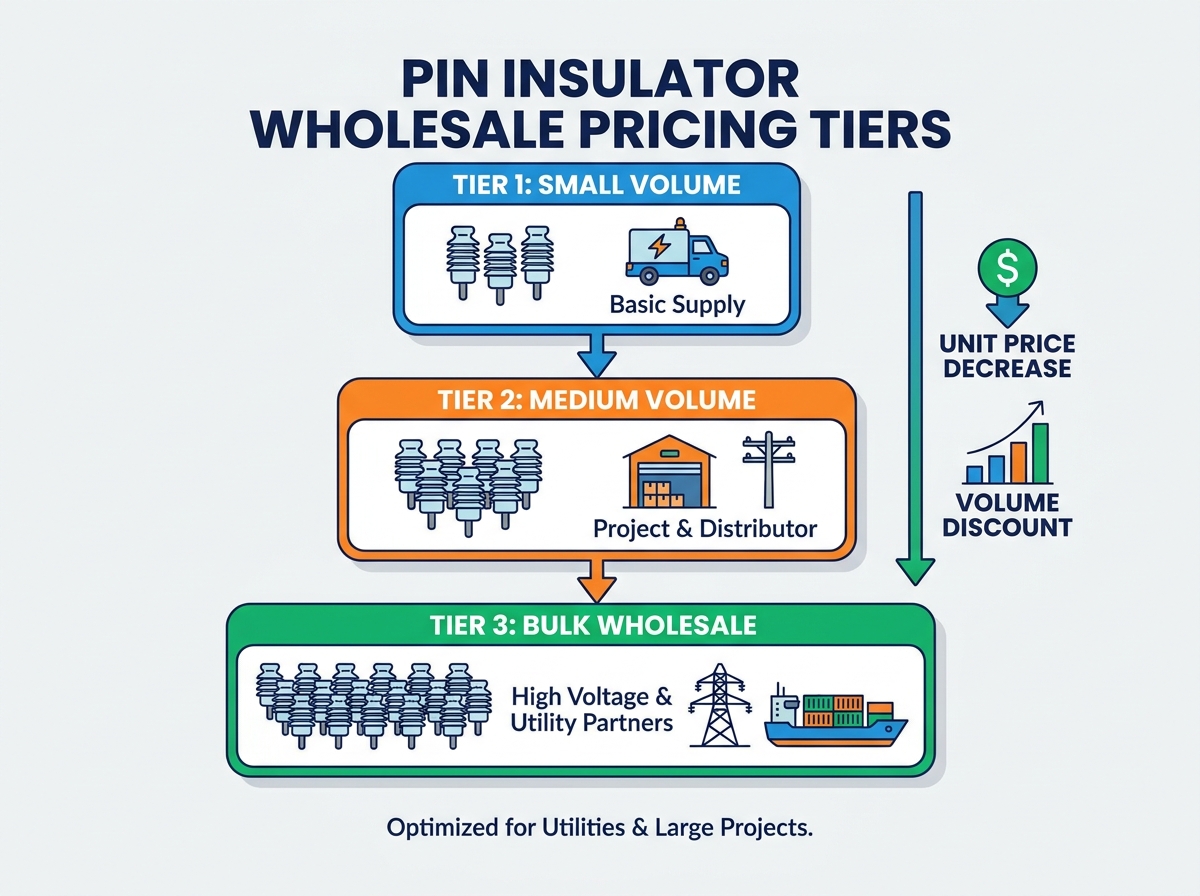
Manufacturers structure their pricing based on production efficiency, raw material volume, and factory scheduling. Understanding these cost drivers prevents budget overruns during international procurement and empowers buyers to negotiate favorable contract terms.
Standard MOQ expectations typically start at 500 to 1,000 pieces for custom runs or factory-direct pricing. Operating a kiln or setting up injection molding tooling requires significant upfront energy and labor. Small batches disrupt factory efficiency, leading to higher per-unit costs. Suppliers absorb these setup costs more effectively when production runs continuously over several days or weeks.
Discount curves become aggressive at higher volume tiers. Surpassing the 5,000 and 10,000-unit marks unlocks substantial unit savings. Procurement teams often negotiate blanket purchase orders to secure these top-tier discounts. A blanket order locks in the high-volume price while allowing the utility to schedule staggered deliveries over a 12-month period. This strategy optimizes warehouse space, improves cash flow, and guarantees a steady supply of hardware without overwhelming regional staging yards.
Free On Board (FOB) pricing structures dominate overseas supplier quotes. FOB means the manufacturer covers the cost of producing the goods and loading them onto the vessel at the port of origin. The buyer assumes all responsibility, risk, and costs from that point forward. Comparing quotes based solely on FOB figures often presents an incomplete financial picture.
Calculating the final landed cost requires adding ocean freight container fees, marine insurance, import customs duties, and inland freight to the destination staging yard. A low FOB price can quickly inflate if you fail to secure competitive ocean freight rates or miscalculate import tariffs. Procurement managers must work closely with freight forwarders to estimate the total landed cost before awarding a manufacturing contract. You need to know exactly how many units fit onto a standard pallet, and how many pallets fit into a 20-foot or 40-foot container to run accurate freight math.
Hardware rated for elevated system voltages commands exponential price increases due to strict engineering requirements. High Voltage Pin Type Insulators designed for 33kV networks require significantly larger sheds and increased material volume compared to standard 11kV units. The larger physical mass demands longer curing and firing times in porcelain manufacturing, reducing overall factory throughput.
High-voltage components undergo stricter testing tolerances and require advanced dielectric material formulations to prevent internal partial discharge. The increased physical dimensions also reduce the number of units that can fit onto a standard shipping pallet, increasing the freight cost per unit. Buyers must account for these compounding factors when forecasting budgets for high-voltage grid expansions.
Securing authentic factory-direct pricing requires navigating complex global supply chains and structuring payments to protect capital investments. Relying on unverified intermediaries often leads to inflated costs and inconsistent product quality.
Digital sourcing platforms facilitate the discovery of overseas manufacturers. These directories aggregate thousands of suppliers, allowing buyers to filter by production capability, export history, and material specialization. They serve as an excellent starting point for building a preliminary list of potential manufacturing partners.
The challenge lies in distinguishing between true manufacturers and trading companies. Middlemen operate on these platforms by masking themselves as factories, adding hidden markups to the unit cost. You must request factory audit reports, verify manufacturing licenses, and demand live video tours of the production floor to confirm you are negotiating directly with the source. Direct sourcing from verified factories ensures transparent communication regarding technical specifications and production timelines.
International payment structures rely on risk mitigation for both parties. The industry standard requires a 30% deposit upfront to initiate production and procure raw materials. The supplier expects the remaining 70% balance upon presentation of the Bill of Lading, proving the goods have shipped and are under the control of the ocean carrier.
For massive infrastructure orders, negotiating Letters of Credit (L/C) protects utility budgets. An L/C guarantees payment through a bank only after the supplier presents strictly compliant shipping and testing documents. This financial instrument prevents funds from being released if the manufacturer fails to meet the agreed-upon technical specifications, fails independent lab testing, or misses critical delivery deadlines. Banks review the inspection certificates, commercial invoices, and packing lists meticulously before authorizing the wire transfer.
Auditing manufacturers beyond the initial price sheet prevents supply chain disruptions. A low quote holds no value if the factory lacks the infrastructure to deliver on time or fails to maintain consistent quality control across large production runs.
Defining benchmarks for supplying ability ensures the manufacturer can handle utility-scale orders without subcontracting the work to unvetted secondary facilities. Verifying a factory's claim of producing 30,000 pieces per month requires inspecting their kiln capacity, molding machine count, and workforce size. Buyers should request recent export records to confirm the factory regularly handles high-volume orders.
Lead times directly impact project schedules. Standard production cycles average 45 days, excluding ocean transit time. Buyers must assess a supplier's raw material inventory reserves. Factories holding substantial reserves of alumina, silica, or silicone rubber can initiate production immediately. Suppliers relying on just-in-time raw material delivery face severe delays during global supply chain bottlenecks. Securing reliable Pin Insulator Supply for Utilities demands partnering with well-capitalized manufacturers capable of weathering raw material shortages.
Mandatory Factory Acceptance Tests (FAT) validate batch integrity before shipping. For porcelain units, porosity tests confirm the material is fully vitrified and will not absorb moisture over time. Dye penetration tests reveal microscopic surface cracks that could lead to catastrophic failure under mechanical stress. Dry and wet power frequency withstand voltage tests verify dielectric strength under simulated field conditions.
Procurement mandates must include documentation of ISO 9001 certification to ensure standardized quality management systems are in place. Buyers should require independent third-party lab reports from internationally recognized testing authorities like KEMA or CESI. These reports validate the manufacturer's internal type test data and ensure the product design meets global IEC or ANSI standards without deviation.
A proper factory audit should evaluate the following areas:
Bulk ordering amplifies the financial impact of manufacturing errors. Establishing strict mitigation protocols protects the utility's investment and prevents field deployment failures that could compromise grid stability.
Dimensional mismatches represent the highest risk in bulk hardware procurement. Variations in dry arc distance, shed profile, or thread geometry render the hardware incompatible with existing crossarms and conductor ties. Modifying field infrastructure to accommodate out-of-spec hardware is financially unfeasible.
Mitigation requires mandating pre-production samples. Before authorizing the full production run, the buyer must receive physical samples generated from the actual production tooling. Engineering teams must conduct physical fit-tests with existing crossarms, spindles, and conductor profiles. Only after the engineering department signs off on the physical sample should the 30% production deposit be released to the factory.
Acceptable defect margins exist in all bulk manufacturing processes. The goal is to define the threshold and establish clear financial recourse before the contract is signed. Discovering defective units during installation causes severe labor inefficiencies and project delays.
Negotiating clear warranty terms dictates how the supplier compensates for units that fail post-delivery testing or shatter during standard installation procedures. Establishing a localized buffer stock—ordering 2% to 5% above the required quantity—ensures field crews do not face material shortages due to minor batch defects. The procurement contract must define the exact financial recourse, such as free replacement units on the next container shipment or direct credit notes, for any batches that fail independent laboratory verification upon arrival.
Securing reliable pole-line hardware requires balancing volume negotiations with strict technical validation. Chasing the lowest FOB price without verifying factory capacity, thread tolerances, or material density inevitably leads to project delays and severe budget overruns. Follow these immediate steps to finalize your procurement strategy:
A: MOQs typically range from 500 to 1,000 pieces depending on the manufacturer, material type, and whether the product follows a standard ANSI/IEC specification or requires custom tooling. Higher volumes unlock significant tier discounts.
A: Bundling the spindle with the insulator guarantees thread compatibility and mechanical fit. While specialized fastener suppliers offer alternatives, single-source bundling eliminates the risk of dimensional mismatches and simplifies warranty claims if structural failures occur.
A: Higher creepage distances require more raw material and larger shed diameters to prevent tracking in polluted environments. This increased physical volume directly raises manufacturing costs, kiln firing times, and international shipping expenses.
A: Porcelain requires extensive curing, glazing, and kiln firing times, often extending production schedules. Composite insulators utilize faster injection molding processes, generally resulting in shorter lead times, though both materials typically follow a standard 45-day baseline after deposit.
A: While pin designs are standard up to 33kV, systems operating at higher voltages typically transition to suspension or line post configurations. The mechanical leverage and electrical constraints at higher voltages make pin designs impractical and prone to failure.
A: Request comprehensive routine, type, and sample test reports. Mandatory documents include cantilever strength verification, porosity tests, power frequency voltage withstand data, and lightning impulse withstand reports verified by independent third-party laboratories.
A: FOB (Free On Board) only covers manufacturing and loading costs at the port of origin. Buyers must calculate ocean freight, marine insurance, import customs duties, and inland trucking to determine the true final unit cost delivered to the staging yard.


