
T: +86-18906892820
F4-19037-6#, Yiwu Intl Trade Mart, Yiwu Jinhua, Zhejiang, China (Mainland)

Views: 0 Author: Site Editor Publish Time: 2026-10-27 Origin: Site


Is glass a conductor or an insulator? The answer depends on its conditions. A glass insulator resists electrical current under normal conditions. Learn how temperature, moisture, and voltage affect conductivity, and why glass protects high-voltage power lines.
Glass is classified as an electrical insulator because it has very few freely moving charge carriers under ordinary conditions. In conductive materials such as copper, some electrons can move through the material when an electric field is applied. This movement creates an electric current. Glass behaves differently because its electrons remain more tightly bound within its atomic structure. As a result, ordinary glass resists the flow of electrical current.
This property makes glass useful wherever electrical separation is required. In a power transmission system, a glass insulator supports an energized conductor while separating it from the tower or supporting hardware. It must provide electrical resistance while also carrying mechanical loads from the conductor and line fittings. The material therefore serves both an electrical and a structural purpose. However, insulation performance depends on the glass formulation, dimensions, surface condition, and operating environment. A damaged or contaminated component may perform differently from a clean, intact one.
The term insulator does not mean that absolutely no charge can move under any circumstance. Small leakage currents may occur, and the material's electrical behavior changes with temperature and applied voltage. Under sufficiently severe electrical stress, insulation can break down. Engineers therefore assess electrical strength and service conditions rather than treating glass as completely immune to current. For practical applications, the important point is that glass strongly restricts current flow under its specified operating conditions.
Electricity can pass through glass under certain conditions, but ordinary solid glass is not a good conductor. In a typical room-temperature setting, its electrical resistance is high enough to make it useful for insulation. This differs from metals, where mobile electrons allow current to flow much more easily. The distinction concerns the movement of charge through the material itself, not whether electricity can travel around its surface or through nearby substances.
Surface conditions can change the result. Dust, salt, industrial residue, or moisture may form a partially conductive path across the glass surface. Current can then travel along that path even though the bulk glass remains highly resistive. In electrical installations, this distinction is important because surface leakage can reduce the effective insulation performance of an otherwise intact component. The risk depends on contamination, humidity, surface geometry, and the voltage applied.
Glass also has temperature-dependent electrical properties. As its temperature rises, ionic movement may increase, changing its conductivity. At extreme temperatures, glass can behave very differently from ordinary solid glass. Strong electrical fields can also cause dielectric breakdown, allowing a sudden current path to form through the material. These conditions do not make everyday glass a normal conductor. They show why electrical conductivity must always be considered alongside temperature, voltage, and material composition.
Glass is not an ideal insulator under every condition. Its behavior depends on the glass type, temperature, electrical field, and surrounding environment. At ordinary temperatures, common glass formulations generally resist current flow. At elevated temperatures, however, ions within the material can become more mobile. This may increase electrical conductivity, particularly as the glass approaches a softened or molten state. Different glass compositions respond differently, so there is no single conductivity value that applies to all glass products.
Electrical stress also matters. If the applied electric field exceeds the material's dielectric strength, breakdown may occur. This can create a conductive path through the glass and permanently damage its insulating function. Surface flashover is another possibility. In this case, a discharge travels along the surface rather than through the bulk material. Moisture and pollution can make surface flashover more likely by changing the electrical conditions along that path.
These distinctions matter when glass is used in electrical equipment. A glass insulator designed for overhead power lines must meet specified electrical and mechanical requirements. Its suitability cannot be judged simply by knowing that glass is normally an insulator. Engineers must also account for voltage, temperature, pollution exposure, mechanical loading, and the applicable test standards. Correct design and installation help the component maintain its intended performance during service.
Conductors, insulators, and semiconductors differ mainly in how easily electrical charge moves through them. Copper is a common conductor because it contains mobile electrons that respond readily to an electric field. Glass is generally an insulator because its charge carriers are much less mobile under ordinary conditions. Silicon is a semiconductor, whose conductivity can be controlled through material composition, temperature, and other factors.
These categories are useful, but real materials do not always behave identically under every condition. For example, the electrical resistance of an insulator can change with temperature. A semiconductor may conduct much more readily under certain conditions than it does at low temperatures. Glass can also exhibit increased ionic conductivity when heated. Therefore, classification describes typical behavior rather than an absolute rule for every environment.
The following table summarizes the practical differences.
Material category | Typical behavior | Common example |
|---|---|---|
Conductor | Allows current to flow readily | Copper wire |
Insulator | Strongly restricts current flow | Ordinary glass |
Semiconductor | Conductivity can be controlled | Silicon components |
In power transmission, this distinction explains why metal conductors carry electricity while glass insulators support and isolate them. Both components are essential, but they perform opposite electrical functions. The conductor provides a path for current, while the insulator helps prevent current from flowing into supporting structures. Selecting each material for its intended role supports safe and reliable system operation.
Glass offers high electrical resistance under suitable conditions, along with useful mechanical and environmental properties. Its rigid structure helps it maintain a stable shape, while its insulating behavior supports electrical separation between conductors and grounded structures. Specially manufactured glass can also provide the mechanical strength required for overhead line applications. These characteristics make glass a practical choice for certain electrical insulators.
However, glass does not automatically outperform every other insulating material. Porcelain and polymer materials also serve electrical applications, each offering different combinations of mechanical, thermal, and environmental properties. The best choice depends on voltage level, mechanical loading, pollution, moisture, and installation requirements. Glass may be suitable for one design, while another application may benefit from a different material.
For high-voltage equipment, engineers consider the complete component rather than the base material alone. Shape, thickness, surface profile, creepage distance, fittings, and manufacturing quality all influence performance. A glass insulator must meet the electrical and mechanical requirements of its intended service. Its high resistance is an important advantage, but the final design determines whether it can provide reliable insulation in the field.

Glass is made from a network of atoms connected by chemical bonds. In common silicate glass, silicon and oxygen form much of this network. The electrons involved in these bonds are not freely available to move across the material as they do in a metal. This limits the number of mobile electronic charge carriers and helps explain glass's high electrical resistance.
Glass can also contain ions, including sodium and calcium, depending on its formulation. These ions contribute to the material's chemical and physical properties. Under ordinary conditions, their movement through solid glass is limited. At higher temperatures, ionic mobility can increase, allowing greater electrical conduction. This is one reason glass conductivity cannot be described using a single value for every temperature and composition.
The structure also affects how glass responds to an applied electric field. Before breakdown occurs, the material can become polarized, meaning its internal charges shift slightly in response to the field. This does not mean that a large continuous current flows through it. Instead, polarization is part of the dielectric behavior that allows insulating materials to function in electrical systems. For engineers, the key consideration is whether the material can withstand the expected electric field without excessive leakage, breakdown, or surface discharge.
Not all glass has the same electrical properties. Soda-lime glass, borosilicate glass, and specially formulated electrical glass differ in composition and intended use. Their chemical ingredients influence ionic mobility, dielectric behavior, thermal response, and resistance. As a result, one glass formulation may perform differently from another when exposed to the same temperature or electric field.
Impurities can also affect electrical behavior. Certain ions may increase conductivity, particularly at elevated temperatures. Moisture and contaminants on the surface can create additional leakage paths. For electrical insulators, manufacturers must therefore control the composition and production process to meet the required specifications. The glass must also be formed and processed to achieve suitable mechanical strength and dimensional consistency.
When evaluating a glass insulator, buyers should avoid assuming that ordinary window glass and purpose-made electrical glass are interchangeable. A power-line component must meet requirements for mechanical load, electrical performance, and environmental exposure. Its composition is only one part of the complete design. Verified test results and product documentation provide a more reliable basis for selection than a general description of the material.
Temperature can strongly influence glass conductivity. At ordinary temperatures, glass generally has high electrical resistance. As the temperature rises, ions may move more easily through the material. This can increase conductivity, although the extent of the change depends on composition and temperature range. The behavior of hot glass is therefore different from that of glass used in everyday environments.
At very high temperatures, glass may soften and eventually melt. In this state, ionic movement becomes much more significant, and some molten glass can conduct electricity. Industrial processes may use this property when heating or processing glass. It does not mean that solid glass at room temperature behaves like a metal conductor. The physical state and operating temperature are essential to understanding the difference.
For electrical equipment, temperature must remain within the manufacturer's specified operating conditions. Excessive heat may change material properties and can contribute to damage or reduced service performance. Engineers should consider the actual thermal environment when evaluating insulation. In outdoor power systems, temperature variation is one of several factors considered alongside voltage, moisture, pollution, and mechanical loading.
Tip: Glass conductivity depends on composition and temperature. Avoid applying measurements from molten glass to solid electrical insulators.
Clean, dry glass is generally a strong electrical insulator, but its surface may become more conductive when wet or contaminated. Water can collect dust, salts, and other particles from the surrounding environment. When moisture dissolves soluble contaminants, the resulting surface film may carry electrical current. This creates a leakage path along the glass rather than necessarily through its solid interior.
The distinction is important for outdoor glass insulators. Power-line components may face rain, fog, salt spray, industrial pollution, and changing humidity. Under suitable conditions, contamination and moisture can increase leakage current. If the electric field becomes high enough, a discharge may develop along the surface. This process is known as surface flashover and can interrupt power delivery or damage equipment.
Insulator design helps manage these risks. Creepage distance, surface shape, material properties, and installation conditions all influence performance. Maintenance teams should follow approved inspection and cleaning procedures where required. They should not assume that glass remains equally insulating regardless of surface condition. In practical service, the condition of the surface can be just as important as the electrical properties of the bulk material.
High voltage can cause an insulating material to fail if the electric field exceeds its dielectric strength under the relevant conditions. When this happens, the material may experience electrical breakdown. A sudden current path can form through the glass, potentially causing permanent damage. The breakdown threshold depends on material composition, thickness, defects, temperature, and the duration and shape of the applied voltage.
Surface flashover is a related but different event. Instead of passing directly through the glass, a discharge travels across its surface. Contamination, moisture, and local electric-field concentration can influence this process. Engineers therefore distinguish between the dielectric strength of the material and the flashover performance of a complete insulator. Both are important when designing equipment for high-voltage service.
Electrical breakdown should not be confused with normal leakage current. A small leakage current may occur under operating conditions, while breakdown represents a loss of the intended insulating function. High-voltage equipment must be designed and tested to withstand its specified operating and test conditions. Anyone working near energized equipment should follow established electrical safety procedures rather than testing insulation by applying voltage directly.
Molten glass can conduct electricity because its ions become more mobile at high temperatures. The level of conductivity depends on the chemical composition and temperature. Some industrial glass-melting processes use electrical heating, where current passes through the molten material to generate heat. This application relies on properties that differ significantly from those of ordinary solid glass.
As glass cools and solidifies, the movement of ions becomes increasingly restricted. Its electrical resistance generally rises, although the exact behavior depends on the material. This transition helps explain why a glass product may conduct more readily when molten than it does after cooling. It also shows why electrical properties should always be considered in relation to the material's physical state.
For power-line applications, molten-glass conductivity is mainly a scientific comparison rather than a normal operating concern. A finished glass insulator is intended to operate within its specified electrical and environmental limits. Buyers should focus on the verified performance of the finished product, including its insulation characteristics and mechanical strength. Industrial conductivity data for molten glass should not be used to assess the suitability of a solid glass insulator.
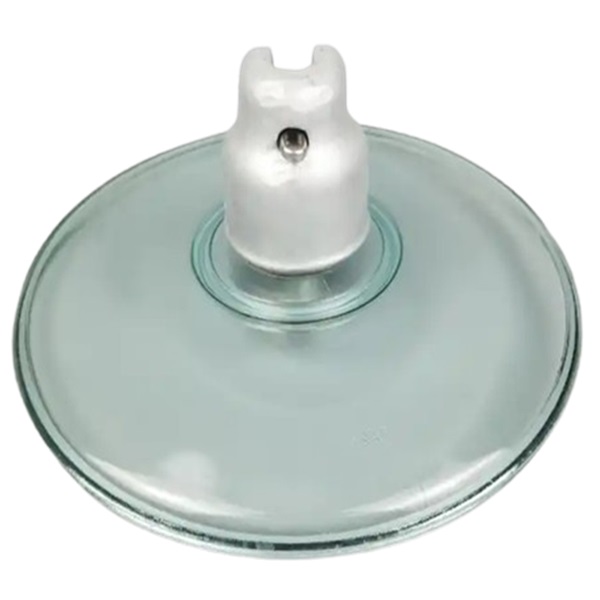
A glass insulator helps support an energized conductor while electrically separating it from grounded structures. In overhead power transmission, this separation is essential because the line must carry current without allowing it to flow through the tower or supporting hardware. Glass offers high electrical resistance under suitable conditions and can be manufactured into shapes designed to withstand mechanical loads.
Electrical performance depends on more than the glass itself. The insulator's shape, creepage distance, fittings, and installation arrangement all affect its behavior. Outdoor units must also tolerate environmental exposure and the mechanical forces associated with the line. Manufacturers therefore design power-line insulators for defined electrical and mechanical requirements instead of relying only on the general insulating properties of glass.
Toughened glass is used in many suspension insulators. Its design combines an insulating glass body with metal fittings that connect individual units into a larger assembly. Buyers should verify the specified mechanical load, dimensions, electrical test data, and applicable standards. The glass insulator product range provides a starting point for reviewing products intended for electrical applications. Final selection should follow the actual project specification.
Glass disc suspension insulators are commonly assembled into strings for overhead power lines. Each unit provides electrical separation and contributes to the mechanical support of the conductor. Several units can be connected in series to create a string suitable for the required voltage and mechanical loading. The string is attached between the supporting structure and the energized conductor using the specified fittings.
The number of units depends on the system voltage, insulation coordination, pollution conditions, required creepage distance, and applicable design standards. A higher voltage does not translate into a fixed number of discs for every installation. Engineers must consider the complete line design, including expected electrical stress and environmental exposure. The string's mechanical rating must also accommodate the loads specified for the project.
Toughened glass suspension insulators are designed for defined service conditions. Their suitability should be confirmed using the manufacturer's technical documentation and relevant test results. For example, the toughened glass suspension insulator U40B represents one product configuration that buyers can examine against their requirements. Its designation should not be treated as a substitute for checking the complete electrical and mechanical specification.
Designations such as U100 and U120 commonly refer to standardized mechanical load classes in applicable glass suspension insulator systems. The number is associated with a specified mechanical failing load, often expressed in kilonewtons. For example, a U120 designation may indicate a 120 kN class under the relevant product standard. The exact interpretation must be confirmed from the manufacturer's documentation and the applicable standard.
This mechanical rating is not the same as the line's operating voltage. A glass insulator may have both mechanical and electrical performance requirements, but one rating cannot replace the other. Engineers must confirm the required mechanical load, electrical withstand characteristics, dimensions, fitting compatibility, and environmental suitability. They should also check whether the designation follows the standard specified by the project.
For procurement, the safest approach is to compare complete model specifications. Confirm the stated mechanical rating, test requirements, and product identification before approving an order. If two products carry similar designations, verify that they use the same standard and test basis. This reduces the risk of treating different products as interchangeable based on a short model code alone.
Glass and porcelain are both used for electrical insulation, but they have different material and design characteristics. Glass suspension insulators can offer visible inspection advantages because damage to toughened glass units may be easier to identify in certain designs. Porcelain insulators have a long history of use and can provide reliable electrical and mechanical performance when correctly designed and installed.
Neither material is automatically better in every application. Performance depends on the complete design, including electrical ratings, mechanical strength, surface profile, pollution exposure, and manufacturing quality. Glass and porcelain products may also differ in weight, handling requirements, and failure behavior. These differences should be assessed against the project's maintenance strategy and operating environment.
Engineers should compare the applicable test results and product specifications rather than relying on broad material claims. They must confirm the required voltage withstand, mechanical load, creepage distance, and environmental suitability. The final decision should reflect the installation's needs, including access for inspection and replacement. This provides a more reliable basis for selection than choosing solely by material name.
Polymer insulators often use a fiberglass-reinforced core and an external insulating housing, commonly made from silicone rubber. They can be lighter than comparable traditional designs and may offer useful surface properties in outdoor environments. Glass insulators use a rigid glass body and are widely used in suspension assemblies. Each design has different handling, inspection, and environmental considerations.
Polymer surfaces may provide hydrophobic behavior, which can help limit continuous water films under suitable conditions. However, performance depends on material quality, aging, contamination, and the specific design. Glass can provide a durable insulating surface, but contamination and moisture may still contribute to leakage or flashover. Neither material removes the need for suitable creepage distance, correct installation, and regular inspection.
Buyers should compare the products for the intended voltage class, mechanical loading, pollution level, climate, and maintenance approach. They should also review manufacturer test reports and service requirements. A lightweight design may be attractive for installation, while another application may favor a different material or construction. The best option is the one that meets the project's documented requirements.
Choosing a glass insulator requires a review of both electrical and mechanical requirements. Engineers should confirm the system voltage, insulation withstand requirements, mechanical load, creepage distance, and expected environmental exposure. Pollution severity and moisture can affect surface performance, while line tension and wind loading influence mechanical design. These factors must be considered together.
Product documentation should also identify the applicable standards, dimensions, fitting configuration, and test results. A designation such as U100 or U120 should be checked against the required mechanical class and the relevant standard. Buyers should confirm that the supplied model matches the approved specification. Where the project has special requirements, such as severe pollution or unusual mechanical loading, these must be addressed during engineering review.
A useful procurement checklist includes:
Required electrical and mechanical ratings.
Creepage distance and environmental conditions.
Dimensions and fitting compatibility.
Applicable standards and test documentation.
Inspection, replacement, and maintenance requirements.
Tip: Ask suppliers to confirm each critical rating in writing and provide documentation for the exact model being quoted.
Dirt and pollution can reduce the surface insulation performance of a glass insulator. Dust, salt, industrial particles, and other contaminants may accumulate on exposed surfaces. When moisture reaches these deposits, it can create a conductive film. Leakage current may then increase, particularly under high electrical stress. If conditions become severe, surface flashover may occur.
The risk depends on the pollution type, humidity, rainfall, insulator shape, and local electric field. Some environments require more frequent inspection or specific cleaning procedures. Maintenance teams should follow the utility's maintenance plan and the manufacturer's instructions. They should also consider whether the installed insulator's creepage distance and design suit the local pollution conditions.
A clean surface does not guarantee that an insulator is free from internal damage. Inspection should cover visible condition, fittings, and other signs of deterioration. The industrial glass insulator for power transmission systems is an example of a product category whose documented specifications can be reviewed when assessing an application. Suitability must be confirmed against the actual operating environment and project requirements.
Inspection can reveal visible cracks, chipped glass, broken units, damaged fittings, or signs of abnormal surface discharge. Such defects may affect mechanical strength or electrical performance. Toughened glass designs can sometimes make damage easier to identify through visible changes in the glass body. However, inspection methods depend on the specific product and the utility's procedures.
A visual check cannot replace all required electrical or mechanical assessments. Inspection teams should use approved methods and follow site safety rules. Any suspected damage should be evaluated by qualified personnel. Units that do not meet the required acceptance criteria should be handled according to the utility's maintenance procedures.
Maintenance records help teams identify recurring problems and plan replacement work. They should record the component location, observed condition, inspection date, and action taken. These records support consistent maintenance decisions and help engineers distinguish isolated damage from broader environmental or installation issues. Electrical equipment should never be touched or tested without appropriate authorization and safety controls.
Quality verification should cover the material, dimensions, mechanical performance, electrical performance, and production traceability. Buyers should confirm that the offered product matches the approved specification. The manufacturer should provide relevant test documentation and identify the standards used for the product. Where required, this may include mechanical load tests, electrical withstand tests, and other applicable type or routine tests.
The exact requirements depend on the insulator type and intended application. A suspension insulator and a pin insulator may have different designs and testing requirements. Buyers should therefore avoid applying one product's ratings to another product category. They should also confirm fitting dimensions and compatibility with the intended line hardware.
For B2B procurement, a documented review reduces the risk of receiving a product that does not match the project specification. Confirm the model designation, rated mechanical load, dimensions, test basis, and delivery documentation before acceptance. If a supplier proposes an alternative, compare its complete technical data rather than relying on a similar appearance or product name. These checks support reliable installation and long-term service.
Glass is generally an electrical insulator, but heat, moisture, and high voltage can affect its performance. Proper selection ensures reliable power line insulation. Load Break Tools offers glass insulators designed for power transmission, supporting electrical isolation and mechanical stability in demanding applications.
A: Glass is generally an electrical insulator because it restricts electron movement.
A: Yes, high temperatures or electrical breakdown can increase conductivity.
A: Moisture and surface contamination can create conductive paths.
A: They provide electrical isolation and mechanical support.
A: Both offer insulation; the best choice depends on application requirements.


