
T: +86-18906892820
F4-19037-6#, Yiwu Intl Trade Mart, Yiwu Jinhua, Zhejiang, China (Mainland)

Views: 0 Author: Site Editor Publish Time: 2026-11-07 Origin: Site


Overhead distribution networks are undergoing a critical material shift. Utility operators and construction firms are moving away from century-old legacy materials like glass and porcelain. You need advanced composite technologies to meet modern grid demands. Right now, field crews face escalating labor costs, strict grid reliability mandates, and high replacement rates for brittle legacy infrastructure. Porcelain and glass are highly prone to handling damage and environmental wear. Transitioning to polymer-based components solves these operational bottlenecks directly. You get verifiable improvements in logistics, installation speed, and long-term mechanical resilience compared to traditional porcelain alternatives across standard distribution voltages. This shift mitigates the inherent weaknesses of ceramics while offering superior performance in heavily polluted or high-vandalism areas. Modern composite technologies provide advanced solutions for challenging environments. They reduce maintenance intervals and improve overall system uptime.
For decades, overhead distribution networks relied heavily on ceramic and glass materials. These components isolate live conductors from grounded supporting structures. While these materials provided adequate electrical insulation, their physical properties introduced severe operational limitations. The most glaring flaw of traditional Porcelain Pin-Post Insulators is their inherent brittleness. Ceramics lack the ability to absorb mechanical shock. Even minor impacts during transportation, offloading, or crossarm mounting induce microscopic fissures within the porcelain body. These invisible micro-cracks propagate over time. When subjected to thermal cycling and mechanical line tension, they eventually lead to sudden and catastrophic structural failure.
Weight presents another massive logistical hurdle. Porcelain is exceptionally dense. A standard 33kV ceramic unit weighs enough to require specialized hoisting equipment just to lift it to the crossarm. This weight penalty impacts every phase of grid construction. It increases transportation fuel consumption. It limits the number of units a single utility truck can carry. It demands heavier, reinforced poles and crossarms to support the dead load. Furthermore, pole-loading calculations must account for this extreme weight. Engineers often restrict span lengths between poles in rural distribution networks to compensate for the heavy ceramic components.
Transporting porcelain requires heavy wooden crating to prevent units from smashing into each other during transit. This packaging adds even more dead weight and requires forklifts for loading and unloading at the utility yard. In polluted environments, the maintenance burden of porcelain becomes overwhelming. Ceramic surfaces are hydrophilic. Water spreads across them in a continuous film. In coastal areas with salt fog, or industrial zones with heavy particulate fallout, this continuous water film mixes with contaminants. It creates a highly conductive path. Utility crews must perform frequent, labor-intensive high-pressure washing to remove these deposits. If they skip this maintenance, the lines experience tracking, leakage currents, and eventual flashovers. This constant maintenance cycle drains operational resources and requires scheduled line outages.
The operational challenges associated with ceramics drove the industry toward advanced composite materials. Modern overhead line design now heavily favors the use of a fiberglass reinforced plastic (FRP) core. Manufacturers combine this core with high-temperature vulcanized (HTV) silicone rubber weather sheds. This dual-material approach separates the mechanical and electrical functions of the component. The central FRP rod provides immense tensile and cantilever strength. It bears the physical load of the conductor. Meanwhile, the HTV silicone rubber housing protects the core from environmental degradation. It provides the necessary creepage distance to prevent electrical faults.
This material shift is fully standardized across modern utility grids. International regulatory bodies established rigorous testing and performance criteria. They aligned these components with updated ANSI and IEC standards, such as IEC 61109 and ANSI C29.13. You will now find Composite Line Post Insulators widely adopted across 11kV, 22kV, and 33kV distribution systems. The manufacturing process of HTV silicone ensures a seamless, void-free bond between the weather sheds and the fiberglass core. This eliminates internal spaces where moisture could accumulate and cause electrical breakdown.
The most immediate and measurable benefit of switching to polymer is the drastic reduction in physical weight. Polymer units typically weigh 80% to 90% less than their exact porcelain equivalents. This lightweight profile transforms warehouse management and site delivery logistics. A utility crew can load hundreds of polymer units onto a standard service truck without exceeding payload capacities. Transporting the same number of porcelain units requires multiple heavy-duty flatbed deliveries. Polymer units pack efficiently in lightweight cardboard boxes. A single worker can manually unload a pallet of polymer units, eliminating the need for heavy machinery at the staging area.
For the linemen performing the actual installation, the ergonomic and safety benefits are substantial. Lifting a heavy porcelain unit up a utility pole often requires block-and-tackle rigging. Crews need bucket trucks and significant physical exertion. In contrast, a lineman can easily carry a polymer unit in one hand while climbing. They position it on the crossarm without specialized hoisting gear. This accelerates the installation process. It reduces physical strain and fatigue. It minimizes the risk of drop-related injuries. Faster installation times mean utility crews cover more miles of distribution line per day. They accelerate grid expansion and storm recovery efforts.
The structural design of a polymer unit offers mechanical advantages that ceramics simply cannot match. The pultruded fiberglass core provides exceptional flexibility and shock absorption. When subjected to sudden mechanical loads, the fiberglass core flexes to absorb the kinetic energy. Think of a tree branch falling on the conductor or severe ice loading. Porcelain is entirely rigid and cannot flex; it simply snaps. This flexibility makes polymer highly resistant to handling drops. If a unit slips from a lineman's grasp and hits the ground, they can typically inspect it, wipe it clean, and install it without issue. A dropped porcelain unit is instantly destroyed.
This impact resistance extends to extreme field conditions. It includes vandalism and seismic activity. In many rural areas, overhead lines are frequent targets for ballistic vandalism. A bullet striking a porcelain shed shatters the entire unit. It drops the live conductor to the ground and causes an immediate outage. When a bullet strikes a polymer shed, it typically passes straight through the silicone rubber. While the shed sustains damage, the fiberglass core usually remains intact. It keeps the conductor safely suspended and prevents a dangerous line drop. During severe storms or pole strikes by vehicles, the lack of heavy, shattering ceramic debris protects utility crews and the public from falling shrapnel.
The chemical properties of silicone rubber provide a massive advantage in wet and polluted environments. HTV silicone is naturally hydrophobic. When rain hits the surface, the water does not spread out. Instead, it forms distinct, isolated droplets. This prevents the formation of a continuous conductive water path from the live conductor to the grounded pin. By breaking up the water film, silicone rubber effectively stops leakage currents. It eliminates dry-band arcing, which is the primary precursor to a full electrical flashover.
Even more remarkable is silicone's ability to maintain this hydrophobicity when covered in dirt, salt, agricultural dust, or industrial pollution. Low molecular weight (LMW) siloxanes within the rubber matrix gradually migrate to the surface. They encapsulate the pollution particles and render the dirt layer itself hydrophobic. This phenomenon is known as hydrophobicity transfer. It means that polymer units actively resist the effects of contamination. Utility operators in coastal salt-fog zones or heavy industrial areas see a dramatic reduction in flashover risks. They achieve this without the need for constant high-pressure washing.
| Performance Metric | Traditional Porcelain | Modern Polymer (Silicone/FRP) |
|---|---|---|
| Weight Profile | Extremely heavy; requires lifting gear and forklifts | Up to 90% lighter; easy manual handling |
| Impact Resistance | Brittle; shatters upon impact, drop, or vandalism | High shock absorption; flexes under mechanical load |
| Surface Wetting | Hydrophilic (forms continuous conductive water film) | Hydrophobic (forms isolated water beads) |
| Pollution Handling | Requires frequent high-pressure washing outages | Self-recovering hydrophobicity; low maintenance |
| Installation Speed | Slow; labor-intensive rigging required | Fast; rapid manual deployment by a single lineman |
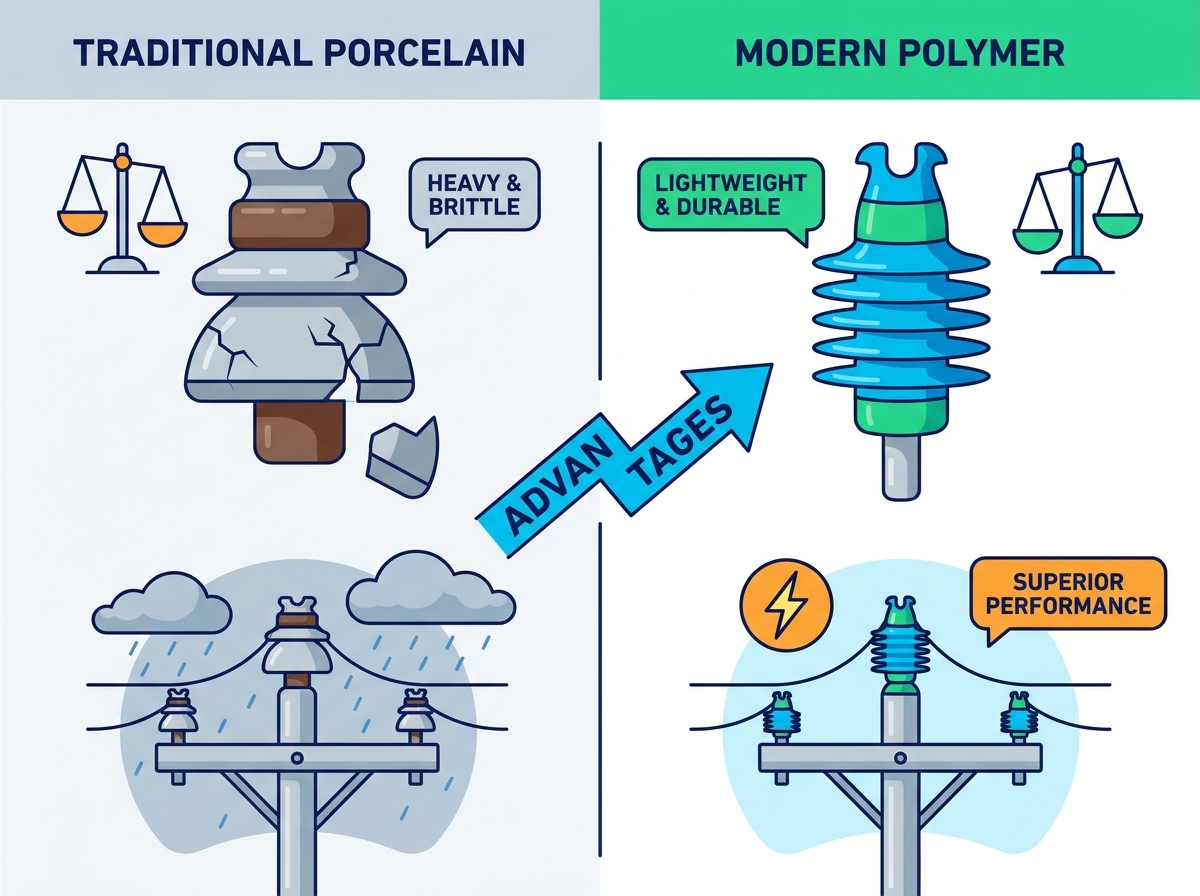
When utility procurement teams evaluate material choices, they look beyond the initial purchase order. They analyze long-term operational efficiency. High-grade silicone polymers provide massive operational savings over their lifecycle. The primary driver of these savings is the drastic reduction in maintenance interventions. Silicone rubber encapsulates surface contaminants and maintains its water-repellent properties. Utility crews no longer need to schedule routine line washing in polluted areas. This eliminates the labor, equipment, and vehicle costs associated with maintaining ceramic lines.
The superior impact resistance of the fiberglass core lowers the annual replacement rate. Fewer shattered units from handling errors, severe weather, or vandalism mean fewer emergency truck rolls. Every time a line drops due to a shattered ceramic component, the utility suffers an outage penalty. This negatively impacts their System Average Interruption Duration Index (SAIDI) and System Average Interruption Frequency Index (SAIFI) scores. By deploying highly resilient polymer components, utilities improve their grid reliability metrics. They keep the power flowing continuously. They allocate their maintenance crews to proactive grid upgrades rather than reactive emergency repairs.
The selection process for overhead line components varies significantly across different distribution voltages. At lower voltages, such as 11kV, the physical size of ceramic units is manageable. However, polymer still offers distinct handling advantages. As the voltage class increases to 22kV and 33kV, the required creepage distance dictates a much larger physical component. At the 33kV level, the weight of porcelain becomes highly prohibitive. Polymer becomes the default engineering choice for new construction and line upgrades.
The versatility of modern Pin Insulator Product Options allows deployment across diverse geographical landscapes. In rural, long-span distribution networks, the lighter weight of polymer allows engineers to design longer distances between poles. They do this without exceeding the mechanical load limits of the crossarms. In dense urban grids, space is limited and installation speed is critical to minimize traffic disruption. The rapid deployment capabilities of lightweight polymer units provide a distinct operational advantage.
Historically, engineers expressed skepticism regarding the long-term outdoor lifespan of non-ceramic materials. Early-generation polymers from the 1980s and 1990s occasionally suffered from severe UV degradation, chalking, and electrical tracking. Modern material science completely resolved these early vulnerabilities. Today's high-temperature vulcanized silicone formulations are heavily engineered. Manufacturers use Alumina Trihydrate (ATH) fillers and advanced UV stabilizers. These chemical additives actively suppress electrical tracking. They prevent the sun's ultraviolet radiation from breaking down the rubber matrix.
When evaluating expected service life, modern polymer units perform exceptionally well across varying climatic conditions. In temperate zones with moderate weather, a high-quality silicone unit easily matches the 30-year expected lifespan of a ceramic unit. Even in harsh environments with extreme UV exposure, high temperatures, and heavy industrial pollution, modern ATH-filled formulations maintain their structural and electrical integrity. Utility engineers must ensure they source current-generation materials rather than outdated formulations to guarantee this extended environmental lifespan.
While polymer units are highly resistant to impact, they are not indestructible. Improper handling during installation compromises the internal fiberglass core. This leads to premature failure. The most critical rule is to never apply torsional stress to the fiberglass rod. When tightening the unit onto the crossarm, linemen must use the designated metal end fittings or base. They must never twist the silicone sheds. Twisting the rubber housing sheers the internal bond between the core and the fitting. This allows moisture to penetrate the seal.
Utility crews must adhere strictly to the manufacturer's torque specifications when securing the mounting stud. Over-torquing the base nut crushes the mounting hardware. It induces stress fractures in the lower fitting. Additionally, crews must use compatible conductor ties. When securing the conductor to the insulator neck, linemen use preformed wire ties. With porcelain, the hard ceramic glaze resists abrasion. With polymer, the silicone rubber is softer. Improperly crimped metal ties cut into the silicone rubber housing. This exposes the FRP core to the elements. Once the core is exposed to moisture and electrical stress, brittle fracture occurs. Nitric acid generated by corona discharge chemically attacks and severs the fiberglass rod. Proper training on handling a Pin Insulator ensures crews avoid these installation errors.
The operational success of a composite deployment relies entirely on the manufacturing quality of the chosen vendor. The market contains a wide range of manufacturers. Not all adhere to strict quality control standards. Procurement teams must define rigorous criteria for evaluating suppliers. The absolute baseline is verifiable compliance with IEC 61109 and ANSI C29.13 standards. Utilities should never accept internal vendor testing alone. They must request comprehensive, independent laboratory test reports. These reports must detail the material's performance under electrical, mechanical, and environmental stress.
The most critical manufacturing vulnerability in any composite unit is the bonding integrity. This involves the junction between the FRP core, the metal end fittings, and the silicone housing. This triple-junction point is the primary defense against moisture ingress. The crimping process attaches the galvanized steel or aluminum end fittings to the fiberglass rod. High-quality manufacturers use a multi-directional, circumferential crimping machine. This applies even pressure around the entire circumference of the fitting. It compresses the metal onto the rod without crushing the glass fibers. Acoustic emission sensors monitor the sound frequencies during this crimping process. If a glass fiber snaps, the sensor detects the specific acoustic signature and rejects the unit. Selecting a vendor with a proven track record of flawless bonding integrity and acoustic emission testing is non-negotiable for long-term grid reliability.
A: Modern high-temperature vulcanized (HTV) silicone insulators with Alumina Trihydrate (ATH) fillers have a realistic service life of 20 to 30 years, depending on environmental conditions. While porcelain can technically last longer in pristine conditions, polymer's resistance to impact and vandalism often results in a longer actual field life by avoiding premature breakage.
A: Yes, they are designed as direct drop-in replacements for traditional porcelain units. They utilize standard mounting studs and base threads. This allows utility crews to retrofit them onto existing wooden, steel, or composite crossarms without requiring any structural modifications to the pole.
A: Silicone rubber is inherently hydrophobic, causing water to bead up rather than form a continuous conductive film. Low molecular weight siloxanes migrate to the surface to encapsulate dirt and salt. This maintains water repellency even when heavily polluted, which prevents leakage currents and flashovers.
A: Initial procurement costs for composite units can sometimes be marginally higher than basic porcelain. However, the massive reductions in freight costs, installation labor, and ongoing maintenance make composite insulators significantly more cost-effective over their operational lifecycle.
A: At 33kV, the required creepage distance makes porcelain units extremely large and heavy, complicating logistics and pole loading. Polymer units provide the necessary electrical insulation at a fraction of the weight, allowing for longer span lengths, easier handling, and less structural stress on the crossarms.
A: Premature failure is almost always caused by moisture ingress reaching the fiberglass core. This typically results from poor manufacturing at the end fittings or improper installation. Applying torsional twisting stress or cutting the silicone housing with improper conductor ties leads to brittle fracture.
A: Field crews perform visual and tactile inspections. They check the silicone housing for any cuts, tears, or signs of separation at the metal end fittings. Polymer units rely on visual confirmation that the weather shed and end seals remain completely intact before mounting.


